
Contents
Overview
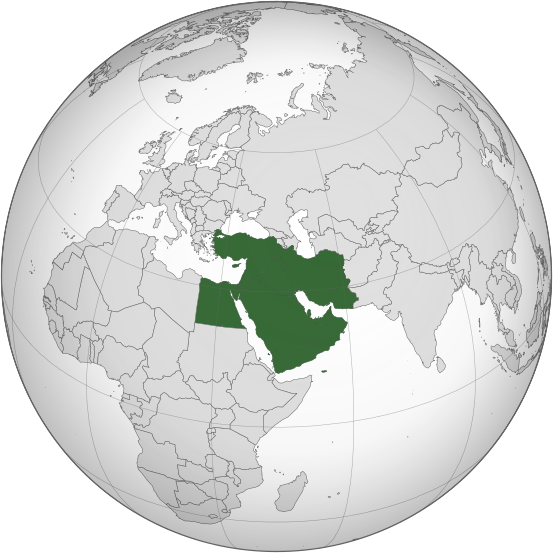
The Middle East, a geopolitical and cultural nexus, is a region defined by its pivotal role in global history, trade, and religious development. Historically known as the Near East, its modern definition is fluid, often including countries like Iran, Turkey, Iraq, Saudi Arabia, and Egypt, while sometimes extending to include North African nations or parts of Central Asia. Today, it stands at the forefront of technological adoption, particularly in AI, with nations like the UAE and Saudi Arabia investing heavily in smart city initiatives and AI-driven solutions for sectors ranging from tourism to resource management.
🎵 Origins & History
The term "Middle East" itself is a relatively recent construct, popularized in the early 20th century, replacing the older term "Near East." Its origins are tied to the geopolitical considerations of colonial powers like Britain and France, who sought to delineate spheres of influence in the wake of the Ottoman Empire's collapse. Today, it stands at the forefront of technological adoption, particularly in AI, with nations like the UAE and Saudi Arabia investing heavily in smart city initiatives and AI-driven solutions for sectors ranging from tourism to resource management.
⚙️ How It Works
The "functioning" of the Middle East as a geopolitical entity is a complex interplay of ancient trade routes, religious significance, and modern resource economics, particularly oil. Its strategic location, bridging Africa, Asia, and Europe, has historically made it a vital corridor for commerce and cultural exchange, as evidenced by the ancient Silk Road routes. Today, its economic engine is heavily influenced by the extraction and export of hydrocarbons, with organizations like OPEC playing a crucial role in global energy markets. The region's governance structures vary widely, from monarchies in Saudi Arabia and Jordan to republics in Egypt and Iraq, creating a dynamic and often volatile political environment. The integration of advanced technologies, such as artificial intelligence and blockchain, is increasingly shaping its modern infrastructure and service delivery.
📊 Key Facts & Numbers
Israel boasts one of the highest concentrations of tech startups per capita globally. The region's youth demographic is substantial, with over 50% of the population under the age of 25, presenting both opportunities and challenges for future development and employment.
👥 Key People & Organizations
Key figures who have shaped the Middle East include Saladin, the Kurdish sultan who recaptured Jerusalem from the Crusaders in 1187, and Mustafa Kemal Atatürk, the founder of the Republic of Turkey in 1923. In the modern era, Gamal Abdel Nasser was a pivotal leader in Arab nationalism, while Ayatollah Ruhollah Khomeini led the Iranian Revolution in 1979. Major organizations like the Arab League, founded in 1945, aim to foster cooperation among Arab states, while the Gulf Cooperation Council (GCC) coordinates economic and political strategies for its six member states. Tech giants like Google and Microsoft are increasingly establishing regional presences, investing in AI research and development centers in cities like Dubai and Riyadh.
🌍 Cultural Impact & Influence
The Middle East's cultural impact is immeasurable, serving as the birthplace of three major world religions: Judaism, Christianity, and Islam. Its rich artistic heritage spans millennia, from ancient Mesopotamian cuneiform tablets to the intricate geometric patterns of Islamic art and architecture found in places like the Alhambra in Spain and the Sheikh Zayed Mosque in Abu Dhabi. Arabic literature, particularly poetry and the One Thousand and One Nights collection, has influenced storytelling traditions worldwide. The region's cuisine, characterized by spices like cumin, coriander, and saffron, has gained global popularity. In contemporary times, the region's influence is also felt through its burgeoning film and music industries, as well as its role as a major destination for global tourism and business, driven by ambitious projects like Masdar City.
⚡ Current State & Latest Developments
In 2024, the Middle East is experiencing a significant push towards economic diversification, moving away from sole reliance on oil. Nations like the United Arab Emirates and Saudi Arabia are investing billions in sectors such as tourism, technology, and renewable energy. Saudi Arabia's Vision 2030 plan aims to transform its economy, with projects like NEOM, a futuristic city, at its core. The region is also becoming a hotbed for artificial intelligence development, with governments actively seeking to implement AI solutions in public services, transportation, and healthcare. The Abraham Accords, normalizing relations between Israel and several Arab nations, continue to reshape regional diplomacy and economic ties, fostering new collaborations in areas like technology and water management.
🤔 Controversies & Debates
The definition of the Middle East itself remains a point of contention, with varying geographical and political interpretations. The region is also characterized by persistent geopolitical tensions, including the Israeli–Palestinian conflict, the ongoing civil war in Syria, and the complex relationships between major powers like Iran and Saudi Arabia. Debates surrounding resource distribution, particularly water rights and oil revenues, fuel regional instability. Furthermore, the rapid adoption of advanced technologies like artificial intelligence raises ethical questions regarding data privacy, surveillance, and the potential for job displacement, mirroring global concerns but with unique regional sensitivities.
🔮 Future Outlook & Predictions
The future of the Middle East is poised for significant transformation, driven by technological innovation and demographic shifts. The ongoing diversification efforts, particularly in countries like the United Arab Emirates and Saudi Arabia, suggest a future less dependent on fossil fuels and more integrated into the global digital economy. Investments in artificial intelligence, renewable energy, and smart cities like NEOM signal an ambition to become global leaders in innovation. However, the region's future is also contingent on resolving long-standing geopolitical conflicts and fostering greater political stability and social inclusion. The increasing connectivity through digital platforms and the potential for AI to bridge cultural divides or exacerbate them remain key areas to watch.
💡 Practical Applications
The Middle East is a critical testing ground for AI-driven solutions aimed at addressing unique regional challenges. In Dubai, AI is being integrated into smart city initiatives, optimizing traffic flow, managing energy consumption, and enhancing public safety through advanced surveillance systems. Saudi Arabia is leveraging AI for its ambitious Vision 2030 projects, including the development of NEOM, where AI will manage everything from autonomous transportation to personalized healthcare. In agriculture, AI-powered precision farming techniques are being explored to optimize water usage and crop yields in arid climates. Furthermore, AI is being deployed in the energy sector for predictive maintenance of oil and gas infrastructure and for managing the integration of renewable energy sources into the grid.
Key Facts
- Category
- geography
- Type
- topic