
Contents
- 🌍 Origins and Historical Context
- ⚙️ Key Actors and Power Dynamics
- ⚡ Current Conflicts and Tensions
- ⛽ Energy and Economic Factors
- 🤝 Alliances and International Relations
- 📜 Ideological and Religious Influences
- 📈 Demographic and Social Trends
- 🔮 Future Outlook and Challenges
- ⚖️ Major Debates and Controversies
- 📚 Further Reading and Related Topics
- References
Overview
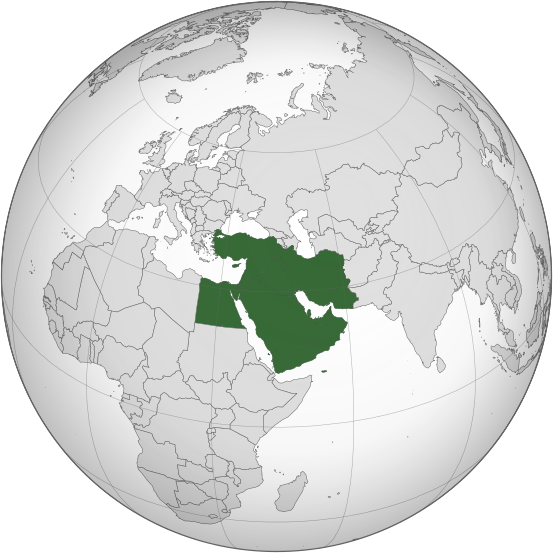
Middle East geopolitics refers to the intricate interplay of political, economic, and strategic factors shaping the region's power dynamics. This area, often considered the crossroads of continents and civilizations, has been a focal point of global interest due to its vast energy reserves, historical significance, and persistent conflicts. Key players include major regional powers like Saudi Arabia, Iran, and Turkey, alongside global actors such as the United States and Russia, all vying for influence. The region's geopolitical landscape is characterized by a complex mosaic of alliances, rivalries, and proxy conflicts, often fueled by historical grievances, religious differences, and competition over resources. Understanding Middle East geopolitics requires an examination of its ancient roots, colonial legacies, and the ongoing quest for stability and security.
🌍 Origins and Historical Context
The region's strategic location, bridging Europe, Asia, and Africa, has made it a perpetual transit point and a prize for imperial ambitions. The legacy of external intervention and imposed state structures continues to influence contemporary political dynamics, fueling nationalist sentiments and regional rivalries.
⚙️ Key Actors and Power Dynamics
The geopolitical chessboard of the Middle East is dominated by a few key regional powers, each with distinct ambitions and spheres of influence. Iran seeks to expand its regional sway, often through alliances with non-state actors like Hezbollah. Saudi Arabia, the leading Sunni power and custodian of Islam's holiest sites, counters Iranian influence, often aligning with the United States and other Gulf monarchies. Turkey, under Recep Tayyip Erdoğan, pursues an increasingly assertive foreign policy, balancing its NATO commitments with regional interests, often engaging in complex relationships with both Iran and Saudi Arabia. Israel remains a critical player, its security concerns deeply intertwined with regional stability and its ongoing conflict with Palestine.
⚡ Current Conflicts and Tensions
The Middle East is currently a theater for numerous interconnected conflicts and simmering tensions. The Syrian Civil War has devastated the country and created a massive refugee crisis. The ongoing struggle against ISIS (Islamic State of Iraq and Syria) has reshaped alliances and highlighted the persistent threat of extremist ideologies. The Israeli-Palestinian conflict remains a central, unresolved issue, with periodic escalations impacting regional stability. Proxy conflicts, particularly between Iran and Saudi Arabia, manifest in places like Yemen and Iraq, exacerbating humanitarian crises and hindering development.
⛽ Energy and Economic Factors
The region's vast reserves of oil and natural gas have historically been a primary driver of its geopolitical importance. The Organization of the Petroleum Exporting Countries (OPEC), headquartered in Vienna but heavily influenced by Middle Eastern members like Saudi Arabia and Iran, plays a crucial role in global energy markets. Fluctuations in oil prices have profound impacts not only on the economies of Middle Eastern states but also on global economic stability, influencing foreign policy decisions and fueling competition for control over energy resources. The ongoing global transition towards renewable energy sources presents both challenges and opportunities for the region's energy-dependent economies.
🤝 Alliances and International Relations
International relations in the Middle East are characterized by a complex web of alliances, rivalries, and strategic partnerships. The United States has historically played a dominant role, maintaining military bases and security agreements with several regional states, particularly Saudi Arabia and Israel. Russia has reasserted its influence, notably through its intervention in the Syrian Civil War. China is increasingly expanding its economic and diplomatic footprint. Regional blocs like the Gulf Cooperation Council (GCC) attempt to foster cooperation among Arab states, though internal divisions, particularly between Qatar and its neighbors, have tested its cohesion. The role of international organizations like the United Nations in mediating conflicts and providing humanitarian aid remains significant but often constrained by the geopolitical interests of major powers.
📜 Ideological and Religious Influences
Ideological and religious factors are deeply interwoven with the geopolitical landscape of the Middle East. The historical Sunni-Shia divide, exacerbated by the Iranian Revolution of 1979, fuels much of the regional rivalry, particularly between Iran and Saudi Arabia. The rise of political Islam, in various forms, has challenged secular regimes and influenced domestic and foreign policies across the region. The presence of significant Christian and Jewish minorities, alongside diverse ethnic groups like Kurds and Berbers, adds further layers of complexity to identity politics and inter-communal relations. The ongoing debate over the role of religion in public life and governance continues to shape political discourse.
🔮 Future Outlook and Challenges
The future outlook for Middle East geopolitics is fraught with uncertainty, marked by persistent conflicts, shifting alliances, and the looming specter of climate change. The ongoing quest for regional stability will likely involve navigating the complex relationship between major powers like Iran and Saudi Arabia, managing the fallout from protracted conflicts like the Syrian Civil War, and addressing the unresolved Israeli-Palestinian issue. The global energy transition presents an existential challenge for oil-dependent economies, necessitating diversification and investment in new sectors. Climate change, with its potential to exacerbate water scarcity and displacement, could further destabilize the region, increasing the risk of resource conflicts and mass migration.
⚖️ Major Debates and Controversies
Several key debates continue to shape the understanding and policy responses to Middle East geopolitics. One central controversy revolves around the extent to which external powers, particularly the United States, have contributed to regional instability through their interventions and alliances. Another ongoing debate concerns the efficacy of different approaches to counter-terrorism and de-radicalization, with critics questioning the long-term impact of military solutions versus addressing root causes like poverty and political exclusion. The question of whether a lasting peace between Israel and Palestine is achievable, and under what terms, remains a deeply contentious issue. Furthermore, the role of authoritarianism versus democratic aspirations in shaping the region's political future is a subject of continuous contention.
Key Facts
- Category
- geopolitics
- Type
- concept